



"I see what's missing. In every process. Every strategy. Every performance review.
My brain hunts for gaps like a bloodhound. It's my superpower. It's why I'm successful. It's why people come to me when things aren't working.
I walk into meetings and immediately spot what's broken. I listen to someone's challenge and my mind races to the solution before they've finished talking. I see their potential and want to fast-track them there.
But here's what's frustrating me: Despite all our conversations about how to change and improve, my people aren't getting it. They're not closing the gaps you're pointing out to them. They're not implementing. They're not growing.
What am I missing?"
SOUND FAMILIAR??
The Problem with Problem-Solving People
The high-achiever’s gap-hunting ability is incredible.
It's what's going to make my university-aged son into a great engineer or entrepreneur one day. It's what made my father into a leading surgeon who could diagnose complex cases and save lives. It’s what helps coaches find the technical details that can change an athlete’s trajectory towards success.
These analytical minds are exactly what we need in technical fields. They get trained early. They get rewarded for it. Excellence demands this skill.
But here's what they don’t teach much in engineering or medical school: bedside manner. The people skills. How to actually connect with humans while you're busy being brilliant.
And it's getting harder. We're more distracted than ever. More impatient. More used to instant everything.
AI can solve problems faster than we can blink. But it can't build genuine human connection. That still requires the old-fashioned approach: time, attention, and patience.
When you're wired to "fix things," you approach humans like mechanical problems. Someone struggling with confidence? Here's a three-step plan. Team lacking motivation? Five strategies coming right up. Employee underperforming? Time for feedback and a performance improvement plan.
But here's what we've forgotten: People aren't problems to be solved.

The Real Gap is Not What You Think It Is
You think the gap that needs closing is external. Between current performance and desired results. Between where they are and where they need to be.
But the gap that actually matters? It's the space between you and them.
It's the relationship gap. The trust gap. The "do they feel like we're on the same team" gap.
This is the REAL gap that's been missing all along.
Think about your own journey to success. Yes, you needed that problem-solving brain. But did you do it alone?
Who saw your potential before you did? Who believed in you when you doubted yourself? Who took time to understand what motivated you, what scared you, what made you tick?
You needed relationships. You needed attunement. You needed to feel valued and seen and heard by someone.
Your people need the same thing.
Thanks for reading The Thriving Achiever: Excellence Redefined! Subscribe for free to receive new posts and support my work.
Play Catch not Ping Pong
The research is crystal clear: Leaders who connect with their people get better results. Athletes perform better for coaches they trust. Students learn more from teachers who "get them."
So what do we high-achievers do with this information? We turn connection into another problem to solve! We read books about emotional intelligence. We practice our "active listening face." We schedule one-on-ones because we should.
But here's the thing: You can't hack genuine connection.
You can't efficiency your way into someone's trust. You can't shortcut to the good stuff.
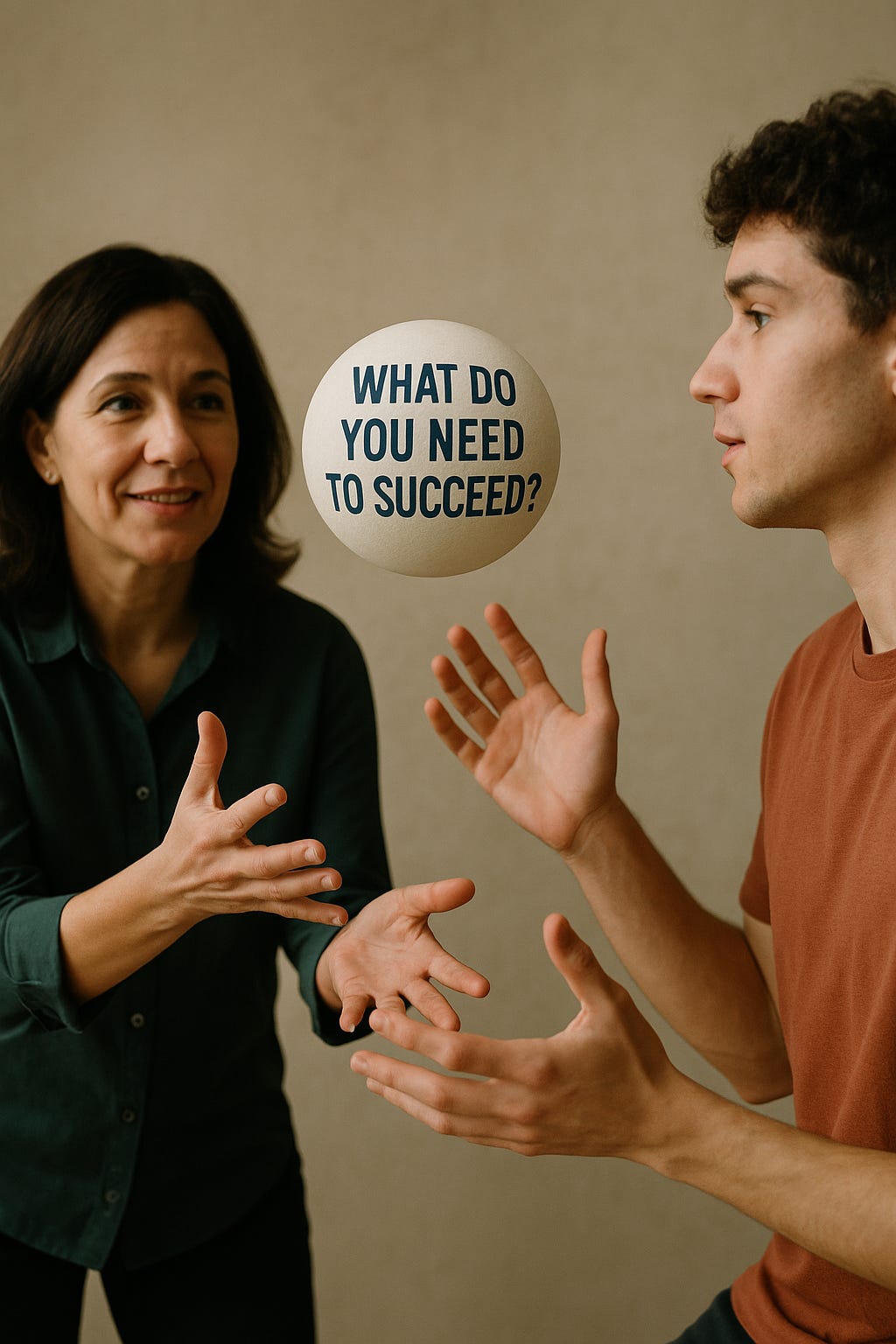
Think about it this way: Most of us communicate like we're playing ping pong. Quick volleys back and forth. Rapid-fire exchanges. Trying to get to the point as fast as possible.
But real connection happens when you're playing CATCH. You throw the ball gently. You watch to see if they're ready. You give them time to catch it properly. Then you wait for them to throw it back when they're ready. You catch what they’re saying. You keep your eye on the ball (the message they’re sending). You double check to see that the ball landed fully and completely before throwing it back: “Did I get that right?”
Good relationships also don’t just focus on the content of your conversations. You take time to continually improve the PROCESS.
It’s called “meta-communicating”: Talk about how you talk. Talk about how your relationship feels. What’s working? What needs to improve so we can be on the same team and deliver results?
PRO TIP - Ask your team members often: “How are WE doing?”
The Mindset Shift – Same goal, different process
Mechanical thinking: Identify problem → Apply solution → Measure result
Works great for systems, terrible for humans
Relational thinking: Create safety → Build trust → Understand their world → Co-create from that teamwork foundation —> Get bigger ideas, take more risks, get better results
Feels slow, actually creates lasting change. Results WILL follow. Trust me.
Thanks for reading The Thriving Achiever: Excellence Redefined! This post is public so feel free to share it.
#TakeTimeToMakeTime: The Uncomfortable Truth
The solution feels counterintuitive to every fiber of your achievement-oriented being: You need to slow down.
You need to take time to make time. You need to get comfortable with what feels like "unproductive" time spent simply being with people.
This means:
I know, I know. It feels inefficient. It feels like you're not doing your job. Every instinct screams, "But we could be solving things right now!"
But sometimes the simplest approach works best.
An athlete I work with recently told me about his debrief meeting with his coach. The main thing that stuck with him wasn't any technical feedback. It was when his coach said, "I want to get to know you better so I can coach you better." That simple statement made him want to share more, get to know his coach better too, and feel more hopeful about the season than any performance analysis ever did.
The Magical Payoff
When leaders actually invest in this relationship-first approach, magic happens.
Think about Steve Jobs and Jony Ive. They didn't just collaborate on products. They spent years understanding each other's creative languages. Jobs could have hired any designer. But he invested time in truly knowing Ive's mind. The result? Revolutionary products that changed the world.
John Wooden spent individual time with each UCLA player. He learned their personalities. Their motivations. Their fears. He didn't just coach basketball. He coached humans. Result? 10 national championships.
Oprah and her longtime producer Sherry Salata built a 20-year partnership that revolutionized television. They invested time in truly understanding each other's strengths and perspectives before building an empire together.
These weren't accidental successes. They were the result of leaders who understood that the relationship IS the foundation for everything else.
Close the real gap first, and everything else becomes possible.
The beautiful irony? When you invest time in genuine connection upfront, everything else happens faster. You waste less time because you’re not making (wrong) assumptions about the other person. The feedback lands better. The strategies stick. The changes sustain themselves.
Your Challenge This Week
Pick one person you're trying to "help" or "develop." Instead of focusing on what you think they need to fix, try this radical experiment:
Spend your next interaction with them focused entirely on understanding their perspective.
Don't offer solutions. Don't give advice. Just be genuinely curious about how they see their situation. What they're experiencing. What matters to them. What motivates them.
Notice how uncomfortable this feels. Notice your brain wanting to jump to fix mode. Breathe. Stay present. Trust the process.
These are no longer called “soft” skills. They are POWER skills, crucial for success. Don’t take my word for it - Look and you will see early tangible results in energy, confidence, and focus that no doubt translate to performance metrics.
You might just discover that the person you thought needed fixing was actually just waiting to be seen so they knew it was safe to shine their light.
Remember: Being on the same team isn't a prerequisite to rush through - it's the core competency that makes everything else possible.
I hope you #taketimetomaketime and focus on the REAL gaps this week.
What relationship gaps can you close this week? Send me a DM and let me know - I promise I won't try to fix it. 😉
Written by

Heather Wheeler, Ph.D.
...and the Dimmer Switch mentality that helped him excel AND feel whole again

Heather Wheeler, Ph.D.
Seeing the hidden trauma beneath compulsive exercise and disordered eating


.svg)